8 June 2011
I spent some time last night entering all my flights into an Excel-based electronic glider pilots log that I sourced from Roger's Soaring Blog (thanks for making it Roger!). It's a pretty good free resource and helped me find I'd made a counting error in my printed logbooks (NZ and Australian) and confirm that I'm rubbish at adding up time!
Accordingly, I find I have more hours and six more flights than I thought I had (I had strangely duplicated some flight numbers, so my numbers in my printed logbook went 55, 50, 51 etc). I've corrected them now, making my messy logbook even messier.
I can encourage anyone reading the blog to download Roger's file and give it a try. It provides some useful summary tables by type, periods etc. Most of the alternative electronic logbooks cost bucks! I will probably password-protect it and upload it to Google docs.
Another positive side of going through my old books was it revived nice memories of past flights.
Showing posts with label soaring. Show all posts
Showing posts with label soaring. Show all posts
Wednesday, June 8, 2011

Monday, June 6, 2011
Wave over New Zealand
7 June 2011
I travelled to Christchurch NewZealand last week for work related to reconstruction of their transport system after the February 2011 earthquake. I was heading out to the airport early on the morning of my flight back, when I noticed obvious lenticular clouds over the city.
I got my Blackberry out when I was on the plane at the gate and took a few photos, but they didn’t come out very well. However, I got some better shots from the air, as we crossed the alps.


I travelled to Christchurch New
I got my Blackberry out when I was on the plane at the gate and took a few photos, but they didn’t come out very well. However, I got some better shots from the air, as we crossed the alps.
While the phone-camera isn’t the best, the photos are good enough to show the characteristic curved tops of the lennies and to show some stacking of the clouds. Pretty neat.
Being a Saturday, I expected to see some wave flights on the Online Contest (OLC), but there appears to be no flights in NZ that weekend (there was a fair bit of other cloud about, so that may have shut things down).


Wednesday, May 18, 2011
Review: Sailplane Grand Prix in the Andes DVD
I bought this from Cumulus Soaring in the US, along with some other gliding films, and only recently got a chance to really sit down with it.
In a nutshell, the DVD provides some breathtakingly beautiful and expertly filmed footage from the 2010 Grand Prix, but was a bit of a disappointment to me because it didn’t provide a record of the Grand Prix, in terms of results, daily competition footage etc.
 I own the Gladiators of the Sky DVD from 2006 and the subsequent 2007 NZ Grand Prix DVD. Both provide Tour de France style narrated coverage of the GP event, day by day, combining video footage from chase aircraft and computer visualised telemetry to follow the races. It’s a great format, because it gets across both the drama of the competition and the changing fortunes of the national competitors, while also revelling in the beauty of sailplanes in a mountain environment.
The Sailplane Grand Prix in the Andes DVD (also available in Blu-ray) seems to be aimed more at making a case for the grand prix events as a spectator sport worthy of greater exposure, suitable for high-end sponsorship (there’s a lot of sponsor and product focus on the aircraft and through the DVD) and with impeccable green credentials.
Some of these objectives are clearly worthy – for example the filming, the amazing settings, the beauty of the aircraft, and the sophistication of glider tracking and visualisation technology mean that, properly promoted, soaring grand prix could be a successful TV sport. Greater public exposure and awareness can also result in greater involvement of premium sponsors (which is bound to be good for the sport) and one of the DVD items shows possible future full-colour gliders with all-over paintjobs.
However, the sustainable, green arguments for the sport, which the two introductory films push heavily, seem contrived and clunky. While certainly the fact that gliders soar on sun-generated energy lines without engines is a green-friendly idea (and one of the things that constantly amazes me when I fly), I think the conceit pushed in the DVD that grand prix soaring is perfectly matched to a sustainable global future would not survive even a cursory consideration of the impacts of towplanes dragging all the competitors into the sky, the transport from across the globe of gliders and crews, and the fuel use of the various chase planes and helos.
So, what are we left with – well, the DVD has 6 self-contained chapters. The first two are a longer and shorter edited version of a promotional film of the Grand Prix, which gives a professionally-narrated and produced summary of what sailplane Grand Prix is, some of the competitors, and some beautiful footage of gliders flying in the Andes, as well as some great footage of Condors. Some of the footage is of competition flying, but some seems to be either from practice days or specially flown filming trips, because on a few occasions you can clearly see one glider (I think Kawa’s Diana) popping its brakes to stay in position.
The footage of the Andes flying is breathtaking and the camera people have done an incredible job. It is romantic, dramatic and hypnotic and it would be great to show non-flying friends who want to see what gliding is about, but it also looks like it is designed to show some big-time decision makers in a boardroom somewhere. One thing I noticed that helped me come to this conclusion – in addition to the shots of sponsor artwork and pilots drinking from cans so the brand is clearly visible, there’s not a bucket hat in sight! Just bare-headed glamorous pilots like Kawa and Rocca (and Uli Schwenk – not so glamorous, but a great pilot)!
Next up is a piece called Dinamica – One Day in Sailplane Grand Prix, which provides a mix of in-flight footage, computer graphics and interviews, covering one of the competition days (day 6 I think) won by local hero Carlos Rocca. This is the sort of thing I wanted to see more of – I wanted something like this for each day. The graphics show how the lead changes, how pilots make good and bad decisions getting to turnpoints, while racing footage shows ridge-running, thermalling and close flying. Beautiful!
Aquarium is more than 30 minutes of sailplane footage with an electronic style soundtrack and no narration. Perfect for a gliding club to put on at a public display day, it is hypnotic and beautiful, mixing footage of mountain flying with flying over Santiago city, gliders dumping water ballast and flying with Condors.
Kawa in the cockpit has air to air and from the cockpit footage – lovely again; and finally there is a track dedicated to a speeded up computer animation of a day’s race, to show what the tracking system can do.
So, overall it’s a lovely DVD, though for me, it doesn’t satisfy my desire to have a record of the whole Grand Prix, where I can follow each day’s racing (since I couldn’t subscribe to the live coverage).
I had some issues with the subtitles. For a while I couldn’t find how to not have any subtitles on-screen (they really ruined the look). After Cumulus Soaring’s Paul Remde confirmed it was possible to switch off the subtitles, I finally found the sweet setting on my DVD player. Since subtitles were hard-coded to Automatic, I had first to change the language of the disc to “Original” and then the subtitles didn’t display.
In a nutshell, the DVD provides some breathtakingly beautiful and expertly filmed footage from the 2010 Grand Prix, but was a bit of a disappointment to me because it didn’t provide a record of the Grand Prix, in terms of results, daily competition footage etc.

The Sailplane Grand Prix in the Andes DVD (also available in Blu-ray) seems to be aimed more at making a case for the grand prix events as a spectator sport worthy of greater exposure, suitable for high-end sponsorship (there’s a lot of sponsor and product focus on the aircraft and through the DVD) and with impeccable green credentials.
Some of these objectives are clearly worthy – for example the filming, the amazing settings, the beauty of the aircraft, and the sophistication of glider tracking and visualisation technology mean that, properly promoted, soaring grand prix could be a successful TV sport. Greater public exposure and awareness can also result in greater involvement of premium sponsors (which is bound to be good for the sport) and one of the DVD items shows possible future full-colour gliders with all-over paintjobs.
However, the sustainable, green arguments for the sport, which the two introductory films push heavily, seem contrived and clunky. While certainly the fact that gliders soar on sun-generated energy lines without engines is a green-friendly idea (and one of the things that constantly amazes me when I fly), I think the conceit pushed in the DVD that grand prix soaring is perfectly matched to a sustainable global future would not survive even a cursory consideration of the impacts of towplanes dragging all the competitors into the sky, the transport from across the globe of gliders and crews, and the fuel use of the various chase planes and helos.
So, what are we left with – well, the DVD has 6 self-contained chapters. The first two are a longer and shorter edited version of a promotional film of the Grand Prix, which gives a professionally-narrated and produced summary of what sailplane Grand Prix is, some of the competitors, and some beautiful footage of gliders flying in the Andes, as well as some great footage of Condors. Some of the footage is of competition flying, but some seems to be either from practice days or specially flown filming trips, because on a few occasions you can clearly see one glider (I think Kawa’s Diana) popping its brakes to stay in position.
The footage of the Andes flying is breathtaking and the camera people have done an incredible job. It is romantic, dramatic and hypnotic and it would be great to show non-flying friends who want to see what gliding is about, but it also looks like it is designed to show some big-time decision makers in a boardroom somewhere. One thing I noticed that helped me come to this conclusion – in addition to the shots of sponsor artwork and pilots drinking from cans so the brand is clearly visible, there’s not a bucket hat in sight! Just bare-headed glamorous pilots like Kawa and Rocca (and Uli Schwenk – not so glamorous, but a great pilot)!
Next up is a piece called Dinamica – One Day in Sailplane Grand Prix, which provides a mix of in-flight footage, computer graphics and interviews, covering one of the competition days (day 6 I think) won by local hero Carlos Rocca. This is the sort of thing I wanted to see more of – I wanted something like this for each day. The graphics show how the lead changes, how pilots make good and bad decisions getting to turnpoints, while racing footage shows ridge-running, thermalling and close flying. Beautiful!
Aquarium is more than 30 minutes of sailplane footage with an electronic style soundtrack and no narration. Perfect for a gliding club to put on at a public display day, it is hypnotic and beautiful, mixing footage of mountain flying with flying over Santiago city, gliders dumping water ballast and flying with Condors.
Kawa in the cockpit has air to air and from the cockpit footage – lovely again; and finally there is a track dedicated to a speeded up computer animation of a day’s race, to show what the tracking system can do.
So, overall it’s a lovely DVD, though for me, it doesn’t satisfy my desire to have a record of the whole Grand Prix, where I can follow each day’s racing (since I couldn’t subscribe to the live coverage).
I had some issues with the subtitles. For a while I couldn’t find how to not have any subtitles on-screen (they really ruined the look). After Cumulus Soaring’s Paul Remde confirmed it was possible to switch off the subtitles, I finally found the sweet setting on my DVD player. Since subtitles were hard-coded to Automatic, I had first to change the language of the disc to “Original” and then the subtitles didn’t display.
Sunday, May 15, 2011
Nick’s AEF
Sunday 8 May 2011
A workmate, Nick, came out to the club last Sunday on my duty pilot stint, to have an air experience flight. He took some nice photos (some of which I wish I’d taken myself).
 |
| ASK-21 SXQ landing |
 |
 |
| Diving |
 |
| Steep turn |
Tuesday, May 10, 2011
Duty Pilot after an absence
Sunday 8 May 2011
Looking at my log book, I haven’t flown for almost 7 months! Starting a new job, with quite a bit of travel, as well as the usual complex family things that come with an elderly parent having to go into care, along with terrible weather in the Sydney Basin
I had planned to celebrate my 50th birthday in wave over Omarama NZ, but my birthday has come and gone and I’m still earthbound.
 |
| ASK-21 with Spin Kit Fitted |
The duty pilot roster had me on duty on Mother’s Day this year. I didn’t realise the date when I had my chance to request date changes, so I had to do some grovelling before leaving my family early on Sunday morning.
It is getting colder in Sydney
Well, it wouldn’t be a duty pilot day for me without complications and today there were a few. I was expecting a quiet day, being Mother’s Day, but it was pretty busy. In addition, one of the single-seaters – the Junior – had a flat tire and the tire on the tail dolly used for both of our ASK-21 two-seaters was also flat, even after a repair. This would make it difficult to handle our main training aircraft, especially on the hill down from the hangars to the strip. As well, both the tractor and Daihatsu towing vehicles were running poorly.
As aircraft were being pulled out, washed and DI’d, a few folk got to work on the dolly tire. None of our pumps would fit the difficult valve location, so in the end the whole wheel assembly was swapped out for a spare.
The Junior tire wasn’t able to be repaired until later, so that ship was left at the hangars for the day.
The day also started with an end change (the pie cart was at the end of runway 06, but operations for the day started from runway 24) so there was a bit of extra time needed to get set up. But, we were finally ready to go around 10.30 am and luckily our two Air Experience Flight (AEF) bookings arrived a half hour early and together, so I took the opportunity to get them both in the air as the first two flights. While this meant they didn’t have very long flights (there was some extensive cirrus so it was cool and no lift), they did get smooth flights and while there was a lowish inversion, the air was otherwise clear, so they got some good views.
 |
| Lovely privately-owned Libelle |
As usual when I’m at the helm there was an end change before noon, despite there being almost no breeze at all, so another half hour was lost in shuttling gliders and the pie cart from one end of the strip to the other. It was funny to see the Sydney Gliding self-launching ASK-21 easily taxi down the strip under its own power and quickly get airborne from zero-six. Luxury.
Once established on zero-six we got operating again. Initially all the flights were short ones due to the lack of any lift, including one member who took a tow to 7,000 feet (!) hoping to get away, or contact some wave he suspects lurks out to the west. However, after lunch the cirrus had contracted north-east and thermals quickly began to pop, with some small cus forming south-west of the strip.
Flights got longer and a workmate, Nick, who had come out for an AEF on “mates rates” decided to take a 4,000 foot tow and got a nice 46 minute flight including some aerobatics.
One of the unwritten jobs of the duty pilot is to make sure everyone gets to fly (except himself or herself as it usually happens) and for some young students who have been driven by their dads great distances for hopefully more than a 30 minute flight in a 9 hour day, so towards the end of the day, when some students were hoping to get a second flight and other members had turned up late hoping to get one flight, I was running around like a mad thing trying to satisfy everyone’s desires – racing to retrieve gliders. This resulted in the last landing of one of our K21s being at last light!
This was the first time I’ve had to put gliders away in the dark and it meant a late return home on Mother’s Day. And of course, in common with almost all my duty pilot gigs, after all that aviation-related activity I was the only one who missed out on a flight!
Wednesday, November 24, 2010
Some days are diamonds…

Nope, I didn’t achieve a gliding goal, I’m referring to the next phrase – “some days are stone.” I was duty pilot again on the weekend and my only goal achieved was to barely keep things operating on a busy and very hot and sweaty day. I didn’t even get to fly myself which is a bit of a pattern for duty pilot days.
I attended an extraordinary general meeting at the club on the Saturday evening to help make a quorum for a vote on the club buying a new ASK-21 (which vote passed successfully). The club’s two metal IS-28s are essentially either unserviceable (awaiting parts) or life-expired. Now with the club’s only K-13 in the workshop (and the previous K-13, which would have required extensive work to bring it back to flying condition, sold), the shortage in two-seaters exposed the need to keep the fleet current and supported.
The current ASK-21 has been popular and resulted in a jump in use. Plus they are pretty bullet-proof, benign, so a good trainer, rarely subject to ADs still being made, have been around a long time, but still look modern.
I think this latter point is important for air Experience Flights (AEFs) and trainee pilots. While I learnt a lot flying IS-28s, I never liked the look of them – like a cross between a vintage car and a Russian tractor. Lord knows what an AEF would think of it. And while the K-13 is a pretty aircraft and nice to fly, it looks like a world war one vintage plane.
I think the ASK-21 is the right way to go for a glider that will be used potentially for training as well as air experience flights.
I slept overnight in the clubhouse ($8.00 – bargain expect for the mossies) but it was a hot uncomfortable night. However, it helped me to be there for duty pilot duties the next day without having to drive more than a hundred kilometres late at night and early in the morning.
It was one of those days – hot – about 35 degrees and incredibly humid, with a building sky threatening thunderstorms, there were a bunch of students, an AEF (and another who walked up with a gift certificate) and two families inquiring about flying for their kids. Along with a shortage of two-seater gliders for training and AEFs, it made for a busy day. A general absence of experienced club members meant that the workload was pretty high (experienced members will grab a car or tractor for retrievals etc) for me.
In addition, two new tug pilots were being trained and in addition to making some of the launches a little bit slower, the tug disappeared for a while over to the fuel bowsers for a new tuggie to be briefed on fuelling procedures. I gained a new respect for tow-pilots though, as one of the new guys positioned the tug just beyond the rope length from the glider, meaning I had to push gliders (complete with crews inside) forward a couple of times so I could hook up the tow-rope!
Organised a reasonable number of launches, but the day seemed to be hectic the whole time, not to mention hot. Two senior members took the DG-1000 off on a bit of a cross-country, which meant we only had one two-seater for a while, so after an hour I got Camden
All in all, a busy day, not an enjoyable duty pilot experience and I didn’t get to fly myself.
Thursday, November 4, 2010
Soaring and Art - Peter Lanyon
An article in the Telegraph on an exhibition, at the Tate gallery, of the work of painter and sculptor Peter Lanyon caught my eye. The article mentioned that Lanyon was a glider pilot (With his discovery of gliding in 1959, Lanyon’s paintings became looser and more ethereal as he attempted to capture the rush of air and movement, the sense of floating between states of atmospheric pressure that are invisible to the naked eye) who died after a landing crash in August 1964.
 |
| Thermal - Lanyon |
I have often thought about the connection between gliding and art and the extent to which flying sailplanes could inspire an artist. In addition to the graceful beauty of the aircraft themselves, you gain a special view of the landscape from a glider – the large canopy, the slow speed, relatively low altitude of most flying and the general absence of engine noise in gliders allows more time to appreciate the view of the ground and sky.
So how did gliding inspire or influence Lanyon? An extract from a review of an exhibition Silent Rhythms by Simon Allen says “The St. Ives painter Peter Lanyon, who took up gliding in 1959, said of his aerial experience: "The air is a very definite world of activity, as complex and demanding as the sea... The thermal itself is a current of hot air rising and eventually condensing into a cloud. It is invisible and can only be apprehended by an instrument such as a glider. The basic source of all soaring flight is the thermal". These meteorological observations found expression in Lanyon's vigorous pictorial language. By untethering himself from the earth to fly above it, he discovered a new way of understanding terrestrial features and their interaction with the ever-changing sea and ambient light.”
In his own words:
‘It is impossible for me to make a painting which has no reference to the powerful environment in which I live.’
‘Paint represents experience and makes it actual.’
Lanyon described landscape painting as 'a true ambition like the mountaineer who cannot see a mountain without wishing to climb it or a glider pilot who cannot see the clouds without feeling the lift inside them. These things take us into places where our trial is with forces greater than ourselves, where skill and training and courage combine to make us transcend our ordinary lives.'
Gliding gave him the chance 'to experience my county from outside returning to land rather than emerging from inside.'
All interesting perspectives I can identify with.
I managed to track down some of his gliding works online and I have to say I like them. Here's a few examples below.
 |
| Soaring Flight - Lanyon |
 |
| Solo Flight - Lanyon |
In Ginger Hill, the black line is 'suggestive of a glider’s path across an autumnal aerial landform'
 |
| Ginger Hill - Lanyon |
Lanyon was born in St Ives in Cornwall, and began exhibiting in 1949. He didn't sell much but received notice from the art world, exhibiting in New York by 1957 and winning a number of prizes.
He took up gliding in 1959, soloed in 1960, got his C in 1961 and his Silver C in 1962. He was flying a Slingsby Skylark 3 (see picture of the type below) at Devon on 27 August 1964 when he had a crash on landing. An eyewitness described it as follows: 'I did observe the latter part of the crash and remember the left wing of the Skylark 3 he was flying in contact with the tarmac runway and bending a great deal. This occurred at Dunkeswell with the Devon and Somerset club before its move to North Hill. I recall being told that Peter was only kept in hospital because of a comparatively minor back injury and then suddenly died when the enforced inactivity allowed a blood clot, formed at a bruise on his leg, to reach the brain.
The glider was not terminally damaged as Ralf Jones repaired and flew it himself until colliding with an Olympia whilst competing in a competition at Nympsfield. I was there tugging in a Tiger Moth at the time and well remember seeing Ralf descend by parachute and land just outside the airfield. Pieces of Skylark rained down for some time afterwards. The badly damaged Olympia arrived on the site with the unhurt pilot still aboard having decided he wasn't high enough to jump by the time he'd got the canopy off.
 Ralf subsequently took-off again to attempt the task in a 4 series Olympia he was in the process of buying. They don't make them like that any more'. Amen!
Lanyon died three days after his crash. Some research into UK crash statistics found that the Skylark's reg was BGA 974 and it's recorded as being written off on 1 July 1964.
Poet W S Graham later wrote a moving tribute to him, called Thermal Stair, 'Find me a thermal to speak and soar to you from.'
Peter Lanyon is the subject of a current exhibition at the Tate St Ives.
Sunday, October 3, 2010
Stick and Rudder

The book's a bit repetitive and simplistic, but it has some important lessons for a glider pilot. Overall, it's an extended lesson about Angle of Attack and the importance of getting the stick forward if things look like getting unstuck.
It's a little quirky and old-fashioned in talking about flippers instead of elevators, and pressing for tricycle undercarriage on planes to cut down on ground loops, but it helped me to understand more about adverse yaw etc. It's the book for convincing (or amazing) non-flyers that the stick controls speed, the engine controls altitude and the rudder doesn't turn an airplane!
For all it's old-fashioned charm, recommended.
Washed out
I was scheduled to be duty pilot today, but the weather forced us to cancel flying. Even though it's a long weekend, there weren't many folk who had put their names down on the flying intentions page. Two students and one AEF, so it would have been a quiet day. Here's the process I went through.
The club has a member who is a meteorologist and he has developed his own section on the club's forum where he makes predictions for upcoming days. Given I live 45 minutes from the club and weather conditions at Camden can be vastly different from home, I can't really look out of my window and work out what the day will be like. I called the Automated Weather Information Service for Camden just after 6.00 am, but it was inconclusive.
I waited until 7.15am but the gliding forecast on the club's forum hadn't been updated, so I had to head out to the club. I got there at 8.00 am to find a grey day, cloud from 1,500 feet to 3,800 feet, and gentle rain. Our tame meteorologist had updated his forecast and indicated that 25mm (1 inch in the old money) of rain had fallen in the past 24 hours and a NOTAM was expected that would close the grass strips that we operate off (too boggy).
However, as Duty Pilot I can't make that call alone, so I had a series of phone calls to make to the Duty Instructor and to the AM tug pilot and the two intending students, as well as the man who had booked the Air Experience Flight (AEF) before wending my way home through the rain.
Disappointing.
The club has a member who is a meteorologist and he has developed his own section on the club's forum where he makes predictions for upcoming days. Given I live 45 minutes from the club and weather conditions at Camden can be vastly different from home, I can't really look out of my window and work out what the day will be like. I called the Automated Weather Information Service for Camden just after 6.00 am, but it was inconclusive.
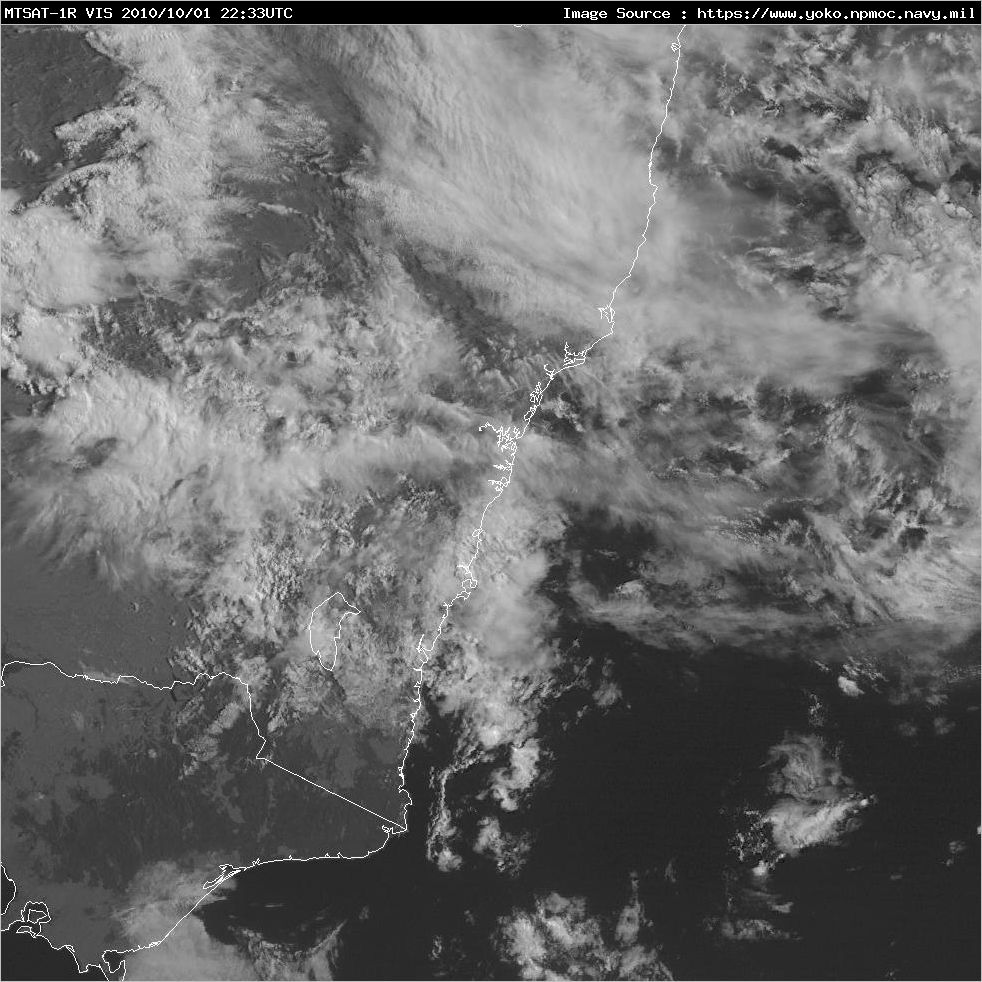 |
| Sydney Weather 2 October 2010 |
However, as Duty Pilot I can't make that call alone, so I had a series of phone calls to make to the Duty Instructor and to the AM tug pilot and the two intending students, as well as the man who had booked the Air Experience Flight (AEF) before wending my way home through the rain.
Disappointing.
Monday, September 27, 2010
Cloud Appreciation Society
I recently joined the Cloud Appreciation Society. I've often visited their site to look at photos of clouds (I could look at them for ages) and after a commercial flight where I watched an English documentary about the founder, Gavin Pretor-Pinney, I joined my 5 year old daughter. It was cheap - just £4 and they sent her a lovely certificate on heavy card/paper and a little badge to wear.
So to the cloud photo that illustrates this posting. It's a lovely big Cumulonimbus taken by Dutch National Gliding Team Member Frank Hiemstra in the Slovak Republic, during the training days for the 2010 World Gliding Championships. I saw it while I was browsing his Flikr stream here and Frank kindly gave me permission to use it here.
He's clearly a cloud fan because most of his photo streams contain one or two dramatic cloud photos but he didn't let them distract him from tasks in the Club Class of the WGC, taking third place on Day 7. So thanks Frank and good luck in future, and I encourage everyone to check out the Cloud Appreciation Society.
 |
| Cb by Frank Hiemstra |
Clouds are important for aspiring glider pilots. My daughter and I love laying on our backs on the grass looking at clouds and imagining what shapes they remind us of and I have been teaching her how to identify cloud types. She can easily recognise Cumulus and Cirrus clouds now and understands (I think) how Cumulus clouds mark thermals. My wife of course can even look at a sky and state that it's "over-developed," though I suspect this is often a ploy to convince me a day was better spent at home than at the gliding strip.
Even my two-year-old can now call out "look, a Cumulus cloud!" and be right most of the time.
So after some encouragement from my daughter, I joined up last week. I'm still waiting on my certificate and badge to arrive from the UK, but I'm member 23 thousand and something. It's quite an organisation and I encourage people to browse the many wonderful cloud photos on the site.
So to the cloud photo that illustrates this posting. It's a lovely big Cumulonimbus taken by Dutch National Gliding Team Member Frank Hiemstra in the Slovak Republic, during the training days for the 2010 World Gliding Championships. I saw it while I was browsing his Flikr stream here and Frank kindly gave me permission to use it here.
He's clearly a cloud fan because most of his photo streams contain one or two dramatic cloud photos but he didn't let them distract him from tasks in the Club Class of the WGC, taking third place on Day 7. So thanks Frank and good luck in future, and I encourage everyone to check out the Cloud Appreciation Society.
Monday, September 20, 2010
My longest flight so far
I am now on check solo with the club, requiring a dual check with an instructor before each solo flight (5 in total before going to daily checks), so I had my first check flight, which the instructor considered as "a bit mechanical". He suggested a second check flight immediately, saying "you can be smoother Brian", and I was smoother on tow, doing coordinated turns this time and with a much smoother landing. He signed me off for solo and then the waiting started.
It wasn't too busy a day at the club - only one Air Experience Flight (AEF) booked for 12 noon and only three students including myself competing for two training aircraft (our ASK-21 and the ASK-13). The AEF didn't turn up, so it was not a long wait before I was able to go up.
The day had improved somewhat and the flight before mine had managed a 50 minute flight, with the instructor indicating that there was a little lift around (1-2 knots) but you needed to work for it. On my first and second check flights there were a few scattered Cu's, but not far above them, clear small lenticular clouds, indicative of wave. The two airmasses were crossing each other and making things bumpy underneath. By the time I lifted off for my solo flight (only my second at Camden) things had changed and there were larger dark Cu's in an overcast sky (higher cloud) with some blue patches.
Takeoff and tow were those wonderful sensations of lightness and bouyancy from being one person in a two-seater. Quickly got to 3,000 and bunged off and then started wandering about the sky. On this initial flight I had no more plans than making sure I did more than a circuit. I knew I could fly a circuit by myself, I now wanted to see if I could get around the sky and stay up by myself.
It helped that there was some lift about and I quickly found that I could find and centre (reasonably well at first and better later in the flight) lift under these Cu's and I worked up from 2,500 feet to a dizzying (for me) 3,800 feet, near cloudbase! This was wonderful - I circled and thermalled with the vario beeping at me, keeping a lookout for other aircraft (the glider I was in - NKC the club's ASK-21 - is fitted with a Flarm and it regularly told me about other gliders in the air with me, mostly west of me) and exploring. I flew south to the high ground of Razorback, pointed my nose towards the Oaks, (which I couldn't really see, it was hazy as anything up there), headed east back over Camden and well upwind of the strip and just generally flew the glider around. I saw jets and prop planes passing by overhead, spotted other gliders, looked down at birds below me and took lots of photos.
I was ecstatic and had to keep checking that I wasn't all tensed up. A couple of times I found myself with my legs and feet braced as though I was riding a horse and I had to remind mysefl to relax and enjoy things. It took me about 40 minutes before everything smoothed out and I really calmed down and actually enjoyed the sensation of flying about and seeing the sights. I ended up thermalling south of the downwind end of the runway, seeing a single-seater and the K-13 flying beneath me. Lovely.
After almost an hour I thought I should return the glider so others could enjoy the day. The problem now was to lose all the height I had built up. I flew upwind, finding lots of lift, but not pursuing it. Over Camden I circled to lose some height, but I was surprised how long it took me to get back down to joining height.
And as is usual with probably every gliding club in the world, downwind and base were a sea of lift. I had to extend downwind a lot more than I'm used to because I'd lost little height in downwind, so I had a nice long final down to a smooth and pleasant landing.
At one hour 8 minutes, it was my longest flight so far, and even more satisfying was starting to work out that I can do more than just fly a circuit - that I may actually be able to fly a glider successfully by myself!
After a long period of work and family committments, I found a Sunday when I could be entirely selfish and spend a day at the club. The day before had been a lovely warm Saturday, but with ominous cirrus indicating a cooler day to come. Our club's resident meteorologist had forecast reasonable days on the weekend, so in a gloomy overcast Sunday morning I fired the car up for the 55km trip to Camden.
 |
| Thermalling |
The weather's often quite different at Camden compared with Sydney, so the local conditions near my house are no indication of what's happening at the strip.
It was clearer at the strip when I got there (and helped the duty pilot get the aircraft out and washed and DI'd), but there was a lot of high cirrus, with areas of cirrostratus to the north, so it looked like lift would be kept down.
It wasn't too busy a day at the club - only one Air Experience Flight (AEF) booked for 12 noon and only three students including myself competing for two training aircraft (our ASK-21 and the ASK-13). The AEF didn't turn up, so it was not a long wait before I was able to go up.
The day had improved somewhat and the flight before mine had managed a 50 minute flight, with the instructor indicating that there was a little lift around (1-2 knots) but you needed to work for it. On my first and second check flights there were a few scattered Cu's, but not far above them, clear small lenticular clouds, indicative of wave. The two airmasses were crossing each other and making things bumpy underneath. By the time I lifted off for my solo flight (only my second at Camden) things had changed and there were larger dark Cu's in an overcast sky (higher cloud) with some blue patches.
Takeoff and tow were those wonderful sensations of lightness and bouyancy from being one person in a two-seater. Quickly got to 3,000 and bunged off and then started wandering about the sky. On this initial flight I had no more plans than making sure I did more than a circuit. I knew I could fly a circuit by myself, I now wanted to see if I could get around the sky and stay up by myself.
 |
| Over Camden |
I was ecstatic and had to keep checking that I wasn't all tensed up. A couple of times I found myself with my legs and feet braced as though I was riding a horse and I had to remind mysefl to relax and enjoy things. It took me about 40 minutes before everything smoothed out and I really calmed down and actually enjoyed the sensation of flying about and seeing the sights. I ended up thermalling south of the downwind end of the runway, seeing a single-seater and the K-13 flying beneath me. Lovely.
After almost an hour I thought I should return the glider so others could enjoy the day. The problem now was to lose all the height I had built up. I flew upwind, finding lots of lift, but not pursuing it. Over Camden I circled to lose some height, but I was surprised how long it took me to get back down to joining height.
And as is usual with probably every gliding club in the world, downwind and base were a sea of lift. I had to extend downwind a lot more than I'm used to because I'd lost little height in downwind, so I had a nice long final down to a smooth and pleasant landing.
At one hour 8 minutes, it was my longest flight so far, and even more satisfying was starting to work out that I can do more than just fly a circuit - that I may actually be able to fly a glider successfully by myself!
Sunday, July 25, 2010
Duty Pilot - 17 July 2010
After soloing again in May, it's a long wait, because of work and family, until I have the chance of flying again. I am on the roster as Duty Pilot again and I'm so keen to get to the club that I turn out of bed at 6.00 am after getting back from overseas the night before.
Arrive at the club on a cold morning (5 degrees C) before 8am and, with the help of a couple of other members, start getting all the gear ready and off to the hangards to prep aircraft. It's a busy day - 4 Air Experience Flights, a visiting overseas pilot from South America and plenty of trainees and club pilots finishing their annual checks.
The weather is benign with gentle variable winds and the chance of some thermals around 1.30pm, once the ground heats up. The most frustrating thing is end changes by the control tower. We get two of these - shift everything down to 24 and then about an hour later, shift everything back to 06. Each end change kills about 30-45 minutes as the pie cart has to be closed up and laboriously towed by tractor to the other end of the strip; as well as the aircraft on the ground.
A total of 23 launches, all the two-seaters in use, lots of certificates presented and even arranged a few photos of the ASK-21 to be used as the background of first solo certificates (since it's a newish aircraft).
I finally get on the road home at about 5.15pm and I never even got to fly. One of the frustrations of Duty Pilot - I did all I could to make sure others flew (and some folk got in three flights - the longest flight was 1 hour 11 minutes - not bad for a winter day) - but I stayed on the ground.
At least I had the satisfaction of having my first real Duty Pilot experience go off well (with the welcome help of plenty of other club members).
Arrive at the club on a cold morning (5 degrees C) before 8am and, with the help of a couple of other members, start getting all the gear ready and off to the hangards to prep aircraft. It's a busy day - 4 Air Experience Flights, a visiting overseas pilot from South America and plenty of trainees and club pilots finishing their annual checks.
The weather is benign with gentle variable winds and the chance of some thermals around 1.30pm, once the ground heats up. The most frustrating thing is end changes by the control tower. We get two of these - shift everything down to 24 and then about an hour later, shift everything back to 06. Each end change kills about 30-45 minutes as the pie cart has to be closed up and laboriously towed by tractor to the other end of the strip; as well as the aircraft on the ground.
A total of 23 launches, all the two-seaters in use, lots of certificates presented and even arranged a few photos of the ASK-21 to be used as the background of first solo certificates (since it's a newish aircraft).
I finally get on the road home at about 5.15pm and I never even got to fly. One of the frustrations of Duty Pilot - I did all I could to make sure others flew (and some folk got in three flights - the longest flight was 1 hour 11 minutes - not bad for a winter day) - but I stayed on the ground.
At least I had the satisfaction of having my first real Duty Pilot experience go off well (with the welcome help of plenty of other club members).
Tuesday, May 11, 2010
Daily Inspector and last flight of the day

I’m finally up to date with my blog! This weekend I came out to the club primarily to finish the DI course, with hopes of also fitting in a circuit or two afterwards. The DI course was to start bright and early out at the hangars and it was a cool sunny morning. The car’s thermometer read 9˚ Celsius as a drove through the gates at 8.15am. It was quite still on the ground and I was surprised to see a partially deflated balloon on our strip. A Sydney company, Balloon Aloft, operates out of Camden and this was the first time I had seen them here. As one balloon on the ground was being packed away, two more were approaching from the south-west. Apparently there was a SW wind aloft and they were using this to come back to Camden. As I watched, a second balloon descended for a perfect landing on the glider strip.
How do they do this? The third balloon apparently missed his slot and crossed overhead at about 1,000 feet to land east of the field, but two out of the three balloons landed where they wanted to, simply using what wind there was.

The second day of the DI course was interesting and involved getting hands-on with two aircraft – the club’s K-13 (complete with trick airbrake handle) and the single seat Astir, carrying out DIs in small teams (there were 6 of us doing the course) complete with little “traps”, being briefed on the idiosyncrasies of the different club aircraft and then finally pulling bits off to see how they work – the tailplane on the K-13 and the tailplane and port wing on the Astir. After this (all of us passed the course) I got to sign off an independent control check of the K-13.
The course finished about 2.30 pm and I headed down with some of the participants to put my name down to fly. I ate a late lunch and then watched the gliders and power planes doing bumps (including a nice little Chipmunk). It was a lovely calm Autumn day, and warm at about 23˚ C and there was lift to be had (a couple of guys in the club’s DG-1000 had a flight just short of 4 hours), but by the time my chance for a flight came around, it was the last flight of the day. I climbed into the K-21 with half the strip in shadow and took a tow to 2,000 feet in lovely smooth air. After release I obscured the altimeter with a little suction cup provided by the instructor and marvelled at the lovely late afternoon light as I wandered about south of the strip. I concentrated on constant speed coordinated turns at 50 knots until I judged it was time to join the circuit. There were no other aircraft up at that time (getting on to 5.00 pm) so it was a calming, smooth flight, with the field in full shadow and the last afternoon sun on the Razorbacks. I managed the circuit well I thought, and after my landing the instructor (who had been having student flights all day) said “you didn’t scare me once”. He wrote in my logbook “Flew a good circuit and landing” which I was most happy with.
After the flight I stayed to pack away gliders and the tug, then carried batteries back to the clubhouse, leaving well after dark. Satisfying.
Sunday, May 9, 2010
Glorious Autumn Soaring

Looking back over my logbook, I find most of my training flights at Camden have been short, generally under 20 minutes, so it was nice on this day to have an almost 50-minute flight.
The club was operating from runway 24 and I arrived with the intention of doing spins, further to my last instructor’s notes. The aircraft available to me (it was a busy day at the club - pretty much every club twin and single and a couple of private ships were on the line - see the photo) when it was my turn to fly, was the venerable K-13.
My takeoff was a bit messy (two years since I’d flown a K-13) and I took a while to cancel out some bobbing up and down immediately after getting off the deck. Even with forward trim the damn thing wanted to climb and it took real effort to keep it in line behind the tow-plane. It was fine on the climb out.
I had signalled to the tug pilot for a tow to 3,000 feet, but it was a booming day and, as I was discussing potential landout options from the 24 runway in case of a rope break with the instructor, he suddenly bunged me off at about 1,200 feet. Earlier I had watched the pilot of a club single-seater get off tow just beyond the end of the runway and then thermal steadily to 4,000 odd feet before setting off. I had deliberately wound the altimeter around so it would be effectively useless for circuit and landing, which I wanted to do solely by eye. On tow, the variometer had shown steady lift beyond the runway. In reference to the land-out options, the instructor’s comment was “well, let’s take a closer look.” And pulled the plug. After I settled into flying speed and had done my release checks, he said “alright, find a thermal”.
The whole sky was going up and it was easy to find a big 4 knotter just west of the runway. This was glorious flying at Camden, where I had previously scratched around for tiny thermals over the suburbs. Here was a big fat thermal I could ride right up to 4,500 feet. It was still going, but I was getting close to the airspace limit (4,500 this close to Camden) and my intention was to do some spins.
The air was particularly clear, the clearest I had experienced in the normally hazy Camden and I could see out to Lake Burragorang to the west (though I wasn’t high enough to see the lake itself) and in the other direction I could see Port Botany and the Sydney CBD about 50km away.

After a HASLL check, we commenced to spin. The instructor put me into spins both from banked turns and from straight ahead stalls, which I had no problems recovering from (I quite like spins, the sudden precipitous plunge and roll) and then we spent some more time enjoying the day. The sky was still going up so I searched for thermals and regained all my height. At one point I saw the club’s Junior above me and joined his thermal. It’s lovely to fly with another aircraft (though busier, in terms of keeping sight of the other aircraft) because of how graceful gliders look in the air. I managed to climb better than the Junior and just before I reached his altitude (about 4,000) he left the thermal and tracked away east.
Around this point I heard a radio call from a power plane approaching Camden from The Oaks and scanned until I saw him (my instructor saw him first, below and west and yawed the nose to point at it. It still took me a couple of seconds to spot it. Aircraft are hard to see at any sort of distance). The Cessna crossed our nose several hundred feet below.
After a bit more flying it was time to get back down to earth to allow others to fly the K-13, so the instructor decided to throw away some of this height via aerobatics. We did two loops in a row (nose down to 100 knots, then a smooth pull up for 1G at the top), followed by two big chandelles/wing-overs. I’ve never been airsick, but after these manoeuvres done in a short period of time, I felt a bit crook and had to breathe open-mouthed for a while before the stomach settled down!
Having shed some height, I joined the circuit for 24 and managed downwind, base and final without reference to the altimeter. The apparent nose-down attitude of the K-13 meant that I had to really watch my speed as I wanted to have the nose higher for the sight picture I normally see in the other club two-seaters. My final was a little high because I waited a little while before applying airbrakes to establish the overshoot on my aiming point, and ended up having to get more than half-brake out on mid-final. On touch-down though, the plastic grip on the airbrake handle came off in my hand, just as I was applying more brake to shorten the ground-roll! It gave me a bit of a fright, as for a split second I held it in my hand working out what to do with it. I kept the glider under control however. I noticed in the glider’s DI book that the loose handle had been a minor defect for some time. I made sure to put an updated note in the book for subsequent pilots.
So, spins are signed off and I hope just a few more circuits are required before I can have my second first solo. I’m definitely feeling better about judging angles by eye and I can tell I’m more relaxed because final feels so much longer, with seemingly more time to think. In some previous flights things had seemed so hectic and fast after the turn to final.
Daily Inspector Course and an Autumn flight

Saturday 17 April 2010
Last year I started the Club's Daily Inspector (DI) course, to qualify me for carrying out (no surprises here) daily inspections of gliders, to certify them fit to fly for the day. The course is in two parts, each a half-day long, separated by a couple of weeks. Day 1 briefly covers the theory and also involves looking at some of the club aircraft and exploring the practicalities of undertaking DIs as well as quirks of different ships, while the second day is all practical application. I did the first day, then some family emergency prevented me from doing the second day, so I remained uncertified.
Finally the course came around again and I signed up to do the whole thing again. This Saturday was the first day and it proceeded pretty much as it had the previous year, with a video and discussion in the clubhouse followed by some hands-on mostly with the club's IS-28. It's entertaining and about equal parts instruction and ritual humiliation, with the instructor emphasising the need for thoroughness by hiding tools and setting other traps around the glider. Screwdrivers under seat cushions, wrongly attached harness straps, loose screws or missing fuses, poorly secured outlanding gear and his piece de resistance is a bunch of heavy spanners and tools in the rear of the 28's fuselage just forward of the tail, retrieved by a long reach from the access hatch.
After the end of the instruction at about 12.30pm, we students hoping to fly trooped down to the flight line to register with the Duty Pilot. It was a glorious day (see photo) with lots of likely looking Cu's around. I didn't have time for lots of flights or long flights (it was busy) but I managed to fit in a glorified circuit in the K-21. Tow to 2,000 feet, more work on my judgement of angles to the field approaching the
break-off point and in circuit.
I feel like it's starting to come together. I'm happier working out when to join circuit, judging angles in the downwind leg, turning to base and final and landing. I did a nice job I thought and my instructor wrote in my logbook "flying well. Spin checks and a few more circuits." Getting closer.
Thursday, April 29, 2010
Air cadets

Further to being a useful gliding club member, I volunteered to help some of the club members (ex Air Force and/or Air Force Reserve) operate a flying day for the local Air Force Cadets. About 20 cadets would have flights in a club two-seater through the day and there was a call via the usual email contact for members to help out.
I arrived early as usual and helped get the aircraft ready and listened in to the briefing of the cadets, I was offered (and accepted) a quick first flight in the K-21 before the cadet flights began (about 10.00 am). The day started as still, with a misty sky and high cloud. No thermal activity at all and so perfect for circuits. Tow to 2,000 feet was the smoothest I’d ever felt. I could have flown the tow hands-off I reckon.
No lift, but no sink either once I was up there. I worked on judging the break-off point and angles to the strip. I flew my circuit a little wide and still ended up a little high (turned in a bit too early), had to get a fair bit of brake out, then was able to put some away and come in on half brake. I felt more comfortable managing the brakes to keep the aiming point where I want it than I had for a while.
I lost a little directional control on the ground though and end up slewing a little left in the landing run. Not sure what happened. But man, the wheel brakes are good on the K-21, unlike any other glider I’ve flown.
After this first flight (14 minutes), I helped out with getting cadets strapped in, briefed and launched, including making sure each of them participated in a launch – retrieving the tow-rope, signalling the required tow height to the tug pilot, hooking on and waving off etc.
There was lots of this and as the day progressed the weather heated up and the unmistakable signs of an afternoon thunderstorm could be seen in the west (unusual, the usual direction for summer thunderstorms in Sydney is the south).

After a few more launches for the cadets, we’d got the last of them off as lightning started to flicker and a wall of black cloud built up. There was a dramatic storm later, which I raced ahead of down the M5 Motorway home.
Tuesday, April 27, 2010
Too hot to fly

One of the things about being a member of a gliding club is that there's an expectation that members will "put in" to do their bit to help the club operate, rather than just turn up and fly. I've always been conscious of this and make an effort to be part of the club's operations. This usually involves arriving out at the clubhouse early to help pull gliders and the towplane out of the hangar, wash them (I haven't finished my DI course yet so I'm mostly muscle at the moment) and tow them down to the launch point and then later running around to help launch and retrieve gliders.
On this day, which was an unusually hot summer day even for Sydney, getting to about 44 degrees C (over 110 degrees F), I made the decision not to fly when I was due for my second flight, because I was exhausted from the launch and retrieve duties I took on.
By getting out to the club early (about 8.30am which requires me to leave home around 7.30am) I got my name at the top of the list to fly. Initially I was slated to fly the club's K-21, but when in my walk-around (the ABCD checks my club does before beginning the CHAOTIC check) I discovered the plane had not been signed off after its DI (this necessitated tracking down the DI-er and getting him to sign it out), so we pushed it off line and I climbed in the IS-28.
The day was heating up and the buckles and even the harness straps were almost too hot to touch. It was coller aloft but no thermal activity had been triggered yet. I took a tow to 3,000 feet
to work on my angles and circuit heights. While there wasn't lift, there was almost zero sink and so the flight consisted mostly of reviewing and commenting on the angles to the strip without reference to the altimeter, judging when to join the circuit and then doing the circuit without the altimeter. My notes indicate that the instructor thought I was flying well, speed control was good, though I joined the circuit a little early (the fault I am trying to deal with), didn't get more flap out when we hit lift in early base (about the most reliable source of lift at most glider fields) and so was then was a little steep on final, using more brake than the half-brake I want to be using. This landing, while a little steeper than ideal, was better than previous high finals I've been guilty of (where I've even needed to sideslip).
After this flight I spent hours running wings and retrieving gliders (it was so hot I couldn't pick up metal towbars with bare hands) while the day turned into a boomer, with Cu's everywhere (see the photo above - one of many I took in wonder at a sky usually blue and clear of clouds) and pilots talking of the whole sky going up and having difficulty staying within the 4,500 foot airspace close to the strip.
It was too hot to be outdoors, let alone running about in the sun. The sun had a big dark halo and at one pount I looked up and saw a strange zig-zag horizontal rainbow in the sky (I found out later this was a Circumhorizon Arc, an effect created by sun shining through high ice crystals in high cirrus clouds) - it was a strange day indeed.
The upshot was, even though it was a dream day to be in the sky, I was so dehydrated and exhausted, feeling sick and light-headed, that when it came time for my next flight at about 2pm, I declined. I'm pretty sure I made the right, safe decision.
Thursday, January 7, 2010
Hey George, just what is a Horse Child Breakfast?

The classic soaring movie The Sun Ship Game is finally out on DVD and my copy arrived from Tom Knauff’s Knauff & Grove Soaring Supplies. This is a great movie about gliding – not a documentary, but a feature film by Robert Drew, made in the 1970s, of the comps in the runup to 1969 Nationals in Marfa Texas, including footage of that competition. The film focuses on two quite different competitors, George Moffat and Gleb Derujinsky and has some lovely footage of flying, as well as briefings etc at the comps. Some highlights for me include:
- Gleb smoking in the cockpit of his glider during a race (and checking he has his cigarettes with him before launch)
- George Moffat lengthening the wingspan of his glider by sawing the wingtips off with a handheld saw!
- Several landouts and crashes where pieces of gliders (particularly canopies) fly everywhere – attitudes to safety were chillingly different back then
- Plenty of footage of beautiful old gliders, including Libelles, fast becoming my favourite type
The title of this post refers to a typically late-sixties impenetrable and vaguely creepy poem by Richard Brautigan called Horse Child Breakfast, which George Moffat (English lecturer) reads to a class at the beginning of the film. The poem, if you want to check it out, along with others by Brautigan, can be found here: http://shalandar.com/richard-brautigan/pill-versus-springhill-mine-disaster.html - if you work out what a Horse Child Breakfast is, let me know.
Anyway, I’m glad I have a copy to replace the bad version I had downloaded from the net and I look forward to watching it (though I doubt whether my wife will be able to stay awake during it – she fell asleep in the first 10 minutes when I played it before).
Another weekend out west

I’m really cramming some flying into my time in WA and once I again I hired a car and drove out to Beverley early on Saturday morning to arrive in time for the briefing. The plan this weekend was to concentrate on judging height and angles in the circuit. First flight was in the ASK-21 (BSS) and was to 2,000 feet with the altimeter obscured. During the tow we practiced hang-up procedures (what to do if the glider’s tow release doesn’t work), plus the signals from the tow pilot to the glider pilot to check that airbrakes aren’t open, and the wave-off sign. During the tow the instructor asked me to judge our height a number of times and each time told me I was very close, which was heartening.
I’ve always been a bit nervous during instrument-obscured flights and I tend to fly a bit messier than normal and this was the case in this flight, though I was happy with my judgement of height and angles in the circuit.
The next flight (which was by then late afternoon – there’s a lot of waiting around and helping with launches etc in gliding) included boxing the tow “very well done Brian” says my instructor, and then a gentle flight in the beautiful late afternoon light. There was little lift left, though I found and hooked onto a small weak thermal over the town for a gain of a measly 200 feet at 1-2 knots. Finally, I joined downwind and of course this was the only place where there was ample lift, so I had to extend the downwind leg even for this hangar flight. I was happy with my approach and landing.
The next day (the Sunday) was busy, with 5 flights - more circuits with the altimeter obscured and a simulated rope break and ending with a hangar flight in the Pooch. All in all I was happy with my progress and only sorry that my time in WA was coming to an end.
Monday, January 4, 2010
More western flying and some surprises

At this stage of my training I try to reflect on what I’ve learnt after every flight, as well as planning my flights to address some area of my training, or a bad habit. This weekend’s flights gave me plenty to learn from!
After an atrocious Saturday (they reported hail on the airfield before lunch, thankfully before any gliders had been pushed out) Sunday’s weather looked good for flying (maybe not for soaring) so I hired a car and drove out to Beverley that morning. The plan was, after getting the rust off in the ASK-21 the previous week, to do stalls and spins in the club’s Puchacz (since the ASK-21 won’t really stall or spin “properly”, without a spin kit fitted), a type I hadn’t flown before.
Just like someone with an ailment I stupidly googled what it was like to spin and found it had a reputation for killing pilots in spins (not sure if undeserved or not…). So I was a bit nervous before flying the “Pooch”. The spin and stall went off well – the stall was pretty predictable, bit of a buffet and the left wing dropped a little, and the spin was sudden but was under control in less than a turn (though we lost a fair bit of height). Piece of cake.
After the spin, we were still at 2,000 feet so had a bit of a stooge around to get more acquainted with the ship. I thermalled for a little in an intermittent bit of lift (more cloud suck than anything else according to the instructor) then tracked south, west of the airfield. There was a stiffish westerly blowing and right at my altitude was a wedge-tail eagle, sitting facing into the wind just hovering there. I passed him just in front, maybe 15 metres away, twice. What a glorious sight and feeling to be sharing the air with this big bird. He was so close I could see the wind ruffling his feathers and I could clearly see his big eye looking at me as we passed by.
My second flight was much more eventful and much more of a learning experience. The first lesson I learnt was look at the altimeter more closely and double-check that against the view out the canopy. I’d planned a tow to 2,000 feet (2,700 indicated) to just basically stooge around and get used to the Pooch. I had been scanning the altimeter after takeoff as part of some drills related to options in case of rope breaks at Beverley (calling out when passing 200 feet AGL to remind myself that from that height on I could consider turning back to a runway rather than looking for straight ahead landing opportunities) when I looked at the altimeter and suddenly thought “Oh, I’m passing 2,800 feet” and bunged off. I felt pretty stupid when after getting settled I noticed how low we were and realised I’d bunged off at 1,800 (1,100 feet indicated) instead of 1,000 feet higher as intended.
This necessitated some quick thinking. I turned back towards the circuit entry point (which wasn’t far away) and then decided to join the (right hand) circuit, as there was no lift about and the longer I faffed about the fewer options I’d have. However, as I approached the start of downwind and made my downwind call, I noticed another club glider, an ASK-21, joining downwind in front of me and slightly lower. I didn’t hear his call and it turned out that his radio batteries were flat and he didn’t hear my downwind call either.
This presented me with a bit of a quandary. After consulting with the instructor in the back seat about options (turn in early, land long, land on crosswind runway), I elected to do a “normal” circuit and land long and over the other glider (I was higher and could do this). The next few minutes provided me with all the evidence I needed that gliding requires constant thinking and assessment. Decision-making. Everything that the other pilot did and everything my aircraft did and everything that the air around us did, opened up or closed windows for different courses of action. My height and the position of the glider in front closed out a landing on the crosswind runway (RWY 26), so my options were then to continue with a normal circuit and see what developed later.
I was fairly well behind and above the ASK-21, so I definitely had more options than him, but I couldn’t be sure what he would do (he was a recent solo pilot on his first few flights, so I didn’t want to put him under too much pressure). In the end I watched him like a hawk and when he had turned final, I turned final well above him and to the side and landed long, watching him out my window as he touched down. He had been unaware of my presence until I appeared above him on final.
When I climbed out of the cockpit, I was feeling a bit shaken. I’d never had a heavier workload in a circuit before and I seen the potential for a disaster – a wrong move by me or the other pilot could have seen a crash. Similarly, a failure by me to recognise the problem, or to not actually change my procedure (such as continuing with a normal approach) could have been disastrous. I was reading one of Tom Knauff’s newsletters and he talked about Plan Continuation Bias, which is where a pilot fails to recognise or act on the need to change a procedure (due to changed conditions) and continues on with their “normal” plan.
Immediately afterwards I discussed what had happened with my instructor and his main comment was that I could have acted more decisively earlier, by turning to base and final earlier (well before the other glider reached his base leg) and landed longer. This would have had the advantage of showing the other glider my position.
I could have done this, but I was high on downwind and under normal circumstances I would have extended my downwind leg. To turn in earlier than I did would probably have meant full airbrakes or a much longer landing (Beverley’s strip is long though, so it may just have been an inconvenience).
In any case, I certainly learned a few things from this flight, including the need to maintain attention and to constantly reassess the situation and to act, rather than continue on with the normal plan. I also learned a little bit about the pressure that an abnormal situation can place on the pilot and the need for a cool, analytical head.
I also had a late flight in the Pooch and managed to take some photos – the light was beautiful and there were small shower clouds around, which made it even prettier. The trees alongside the main runway at Beverley lead to shadowing of the runway in the late afternoon, which can make it difficult to judge height for roundout, as you go from bright sky into darker conditions on late final. Tricky, but I made it okay.
One additional nice thing about the Beverley club is their tradition of having group dinners cooked by one or two members. Many club members stay overnight at Beverley as its 1.5 to 2 hours drive from Perth and there’s a heap of privately-owned caravans around the clubhouse, as well as some beds in the clubhouse itself and the club developed a tradition where a couple of members buy meat and vegetables and then cook a huge roast dinner, which other club members can partake of for a nominal fee (about $10). The kitchen was busy for several hours on the Saturday of the last weekend I was there and a beautiful roast lamb dinner with apple crumble and custard was provided for more than 20 people. Very neat and I noticed in the club’s magazine that I managed to sneak into the photo!
After an atrocious Saturday (they reported hail on the airfield before lunch, thankfully before any gliders had been pushed out) Sunday’s weather looked good for flying (maybe not for soaring) so I hired a car and drove out to Beverley that morning. The plan was, after getting the rust off in the ASK-21 the previous week, to do stalls and spins in the club’s Puchacz (since the ASK-21 won’t really stall or spin “properly”, without a spin kit fitted), a type I hadn’t flown before.
Just like someone with an ailment I stupidly googled what it was like to spin and found it had a reputation for killing pilots in spins (not sure if undeserved or not…). So I was a bit nervous before flying the “Pooch”. The spin and stall went off well – the stall was pretty predictable, bit of a buffet and the left wing dropped a little, and the spin was sudden but was under control in less than a turn (though we lost a fair bit of height). Piece of cake.
After the spin, we were still at 2,000 feet so had a bit of a stooge around to get more acquainted with the ship. I thermalled for a little in an intermittent bit of lift (more cloud suck than anything else according to the instructor) then tracked south, west of the airfield. There was a stiffish westerly blowing and right at my altitude was a wedge-tail eagle, sitting facing into the wind just hovering there. I passed him just in front, maybe 15 metres away, twice. What a glorious sight and feeling to be sharing the air with this big bird. He was so close I could see the wind ruffling his feathers and I could clearly see his big eye looking at me as we passed by.
My second flight was much more eventful and much more of a learning experience. The first lesson I learnt was look at the altimeter more closely and double-check that against the view out the canopy. I’d planned a tow to 2,000 feet (2,700 indicated) to just basically stooge around and get used to the Pooch. I had been scanning the altimeter after takeoff as part of some drills related to options in case of rope breaks at Beverley (calling out when passing 200 feet AGL to remind myself that from that height on I could consider turning back to a runway rather than looking for straight ahead landing opportunities) when I looked at the altimeter and suddenly thought “Oh, I’m passing 2,800 feet” and bunged off. I felt pretty stupid when after getting settled I noticed how low we were and realised I’d bunged off at 1,800 (1,100 feet indicated) instead of 1,000 feet higher as intended.
This necessitated some quick thinking. I turned back towards the circuit entry point (which wasn’t far away) and then decided to join the (right hand) circuit, as there was no lift about and the longer I faffed about the fewer options I’d have. However, as I approached the start of downwind and made my downwind call, I noticed another club glider, an ASK-21, joining downwind in front of me and slightly lower. I didn’t hear his call and it turned out that his radio batteries were flat and he didn’t hear my downwind call either.
This presented me with a bit of a quandary. After consulting with the instructor in the back seat about options (turn in early, land long, land on crosswind runway), I elected to do a “normal” circuit and land long and over the other glider (I was higher and could do this). The next few minutes provided me with all the evidence I needed that gliding requires constant thinking and assessment. Decision-making. Everything that the other pilot did and everything my aircraft did and everything that the air around us did, opened up or closed windows for different courses of action. My height and the position of the glider in front closed out a landing on the crosswind runway (RWY 26), so my options were then to continue with a normal circuit and see what developed later.
I was fairly well behind and above the ASK-21, so I definitely had more options than him, but I couldn’t be sure what he would do (he was a recent solo pilot on his first few flights, so I didn’t want to put him under too much pressure). In the end I watched him like a hawk and when he had turned final, I turned final well above him and to the side and landed long, watching him out my window as he touched down. He had been unaware of my presence until I appeared above him on final.
When I climbed out of the cockpit, I was feeling a bit shaken. I’d never had a heavier workload in a circuit before and I seen the potential for a disaster – a wrong move by me or the other pilot could have seen a crash. Similarly, a failure by me to recognise the problem, or to not actually change my procedure (such as continuing with a normal approach) could have been disastrous. I was reading one of Tom Knauff’s newsletters and he talked about Plan Continuation Bias, which is where a pilot fails to recognise or act on the need to change a procedure (due to changed conditions) and continues on with their “normal” plan.
Immediately afterwards I discussed what had happened with my instructor and his main comment was that I could have acted more decisively earlier, by turning to base and final earlier (well before the other glider reached his base leg) and landed longer. This would have had the advantage of showing the other glider my position.
I could have done this, but I was high on downwind and under normal circumstances I would have extended my downwind leg. To turn in earlier than I did would probably have meant full airbrakes or a much longer landing (Beverley’s strip is long though, so it may just have been an inconvenience).
In any case, I certainly learned a few things from this flight, including the need to maintain attention and to constantly reassess the situation and to act, rather than continue on with the normal plan. I also learned a little bit about the pressure that an abnormal situation can place on the pilot and the need for a cool, analytical head.
I also had a late flight in the Pooch and managed to take some photos – the light was beautiful and there were small shower clouds around, which made it even prettier. The trees alongside the main runway at Beverley lead to shadowing of the runway in the late afternoon, which can make it difficult to judge height for roundout, as you go from bright sky into darker conditions on late final. Tricky, but I made it okay.
One additional nice thing about the Beverley club is their tradition of having group dinners cooked by one or two members. Many club members stay overnight at Beverley as its 1.5 to 2 hours drive from Perth and there’s a heap of privately-owned caravans around the clubhouse, as well as some beds in the clubhouse itself and the club developed a tradition where a couple of members buy meat and vegetables and then cook a huge roast dinner, which other club members can partake of for a nominal fee (about $10). The kitchen was busy for several hours on the Saturday of the last weekend I was there and a beautiful roast lamb dinner with apple crumble and custard was provided for more than 20 people. Very neat and I noticed in the club’s magazine that I managed to sneak into the photo!
Subscribe to:
Comments (Atom)
